Potholes are not random occurrences. They are the predictable end result of ignored cracks, poor drainage, and deferred maintenance on commercial pavement. This guide explains why potholes form, how professional repair is done correctly, and what property managers can do to prevent them from coming back season after season.
A pothole in a commercial parking lot is a liability event waiting to happen. Damaged vehicles, slip-and-fall incidents, and the legal exposure that follows are real and measurable risks for property managers, asset managers, and facility directors in Ontario. Beyond liability, a lot with visible pothole repair needs sends a clear signal about how the property is managed, which matters to tenants, customers, and institutional clients alike.
The critical thing to understand about potholes is that they are almost never sudden. They develop over time through a predictable failure sequence that starts with surface cracking, progresses through water infiltration, and accelerates dramatically through Ontario’s freeze-thaw cycles. By the time a pothole is visible, the pavement damage typically extends well beneath the surface. Seal Canada works with commercial clients across the Greater Toronto Area to assess, repair, and prevent pothole formation through structured pavement maintenance programs.
How Potholes Actually Form in Commercial Parking Lots
Understanding the formation sequence helps property managers make better maintenance decisions. Pothole formation follows the same pattern on almost every commercial lot:
Stage 1: Surface Cracking
Asphalt binder oxidizes as it ages, losing the flexibility that allows it to absorb traffic load and thermal movement. The surface becomes brittle and develops cracks, which are the entry points for everything that follows. Freeze-thaw cycling widens these cracks: water enters, freezes, expands, and forces the crack open further with each cycle. Ontario’s climate delivers 40 to 60 of these cycles in a typical winter, according to Environment and Climate Change Canada.
Stage 2: Sub-Base Saturation
Once water moves through surface cracks into the granular base beneath the asphalt, it begins saturating the sub-base material. Saturated granular base loses its load-bearing capacity. It can no longer distribute vehicle loads effectively across the subgrade. Every vehicle that crosses a saturated zone pushes the weakened material aside rather than compressing it.
Stage 3: Surface Collapse
With the base compromised beneath it, the asphalt surface layer has no structural support. Vehicle loads flex and crack it further until a section breaks away entirely, creating a pothole. The initial failure is often small, but traffic loads quickly enlarge the opening as more edge material breaks away. At this stage, asphalt repairs are required rather than preventive maintenance.
Why Potholes Are Expensive When Left Unaddressed
Every week a pothole repair is deferred, the failure area grows. Freeze-thaw cycling, vehicle traffic, and rainfall each contribute to expanding the damaged zone. A pothole that measures 30 cm across and costs a few hundred dollars to patch properly can double in size within a single season if ignored, and a pothole over a failed sub-base section requires full-depth reclamation rather than a surface patch.
Beyond repair costs, the liability exposure escalates with the size of the defect. Under Ontario’s Occupiers Liability Act, commercial property owners and managers have a duty of care to maintain their premises in a reasonably safe condition. A documented pothole that was known but left unrepaired represents the clearest possible liability exposure. Prompt response, documentation, and professional repair are the standard of care that protects both users of the property and the property owner.
Vehicle damage claims add another layer of cost. Potholes can damage tires, suspension components, and wheel rims on the vehicles of tenants, customers, and employees. In a commercial property context, these claims typically fall on the property owner or management company responsible for maintaining the lot.
What Professional Pothole Repair Actually Involves
Effective commercial pothole repair is not a simple fill-and-go operation. The root cause of the failure must be assessed before any material is applied, because surface patching over a failed sub-base produces a repair that fails again within one to two seasons.
Step 1: Root Cause Assessment
A qualified contractor assesses whether the failure is surface-only, meaning the asphalt layer failed while the base is still intact, or whether the sub-base has also failed. This distinction determines the repair method and scope. A surface probe or careful excavation of the pothole edges reveals the base condition. Soft or crumbling material beneath the surface confirms base failure.
Step 2: Saw-Cut Patching for Surface Failures
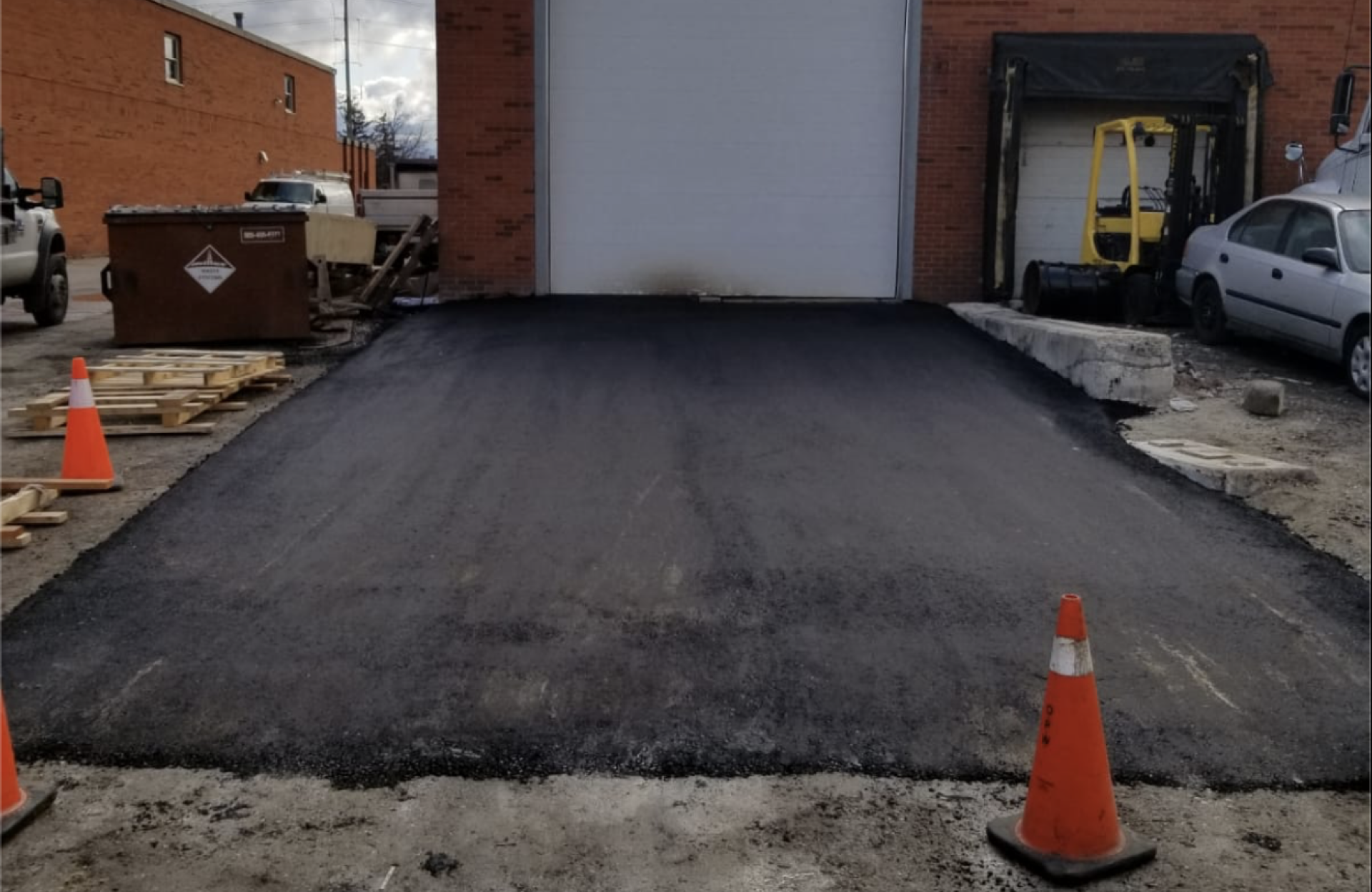
Where the base is intact, the standard repair method is saw-cut patching. The damaged area is saw-cut to clean, straight vertical edges. The saw-cut boundary is set back beyond the visible damage to include any weakened edge material. The area is cleaned, tack coat is applied to bond the new material to the existing asphalt edges, and hot-mix asphalt is placed and compacted to the correct density and grade. The National Asphalt Pavement Association identifies saw-cut patching with proper tack coat application as the repair method with the highest long-term success rate for surface-level pothole failures.
Step 3: Full-Depth Reclamation for Base Failures
Where the sub-base has failed, the repair scope expands to include removal of the failed asphalt layer, stabilization or replacement of the base material, and repaving. This process costs more than a surface patch but eliminates the cycle of recurring failure that surface-only repairs over a compromised base always produce. If the same location develops a pothole repeatedly season after season, full-depth reclamation is the only permanent solution.
Cold Patch: Temporary Use Only
Cold patch material is an appropriate temporary measure to eliminate an immediate hazard when permanent repair cannot be scheduled immediately. It should be packed firmly into the pothole, slightly overfilled to allow for settlement, and treated as a short-term fix that requires follow-up permanent repair. Seal Canada’s commercial paving team schedules permanent hot-mix patches to follow any temporary cold patch application.
Preventing Potholes: The Maintenance Approach That Works
Pothole prevention is less about any single intervention and more about removing the conditions that allow the failure sequence to begin. The three conditions that create potholes are oxidized, brittle asphalt; surface cracks that allow water infiltration; and inadequate drainage that saturates the sub-base. Address all three and pothole formation is largely preventable.
- Sealcoating every two to three years replenishes oxidized binder oils, restores surface flexibility, and seals micro-pores against water infiltration. It is the highest-return preventive measure for asphalt parking lots.
- Crack sealing within the same season cracks appear blocks the water entry point before freeze-thaw cycling can widen it. A crack sealed promptly costs a fraction of the pothole repair it prevents.
- Drainage management, including clearing catch basins twice annually and addressing any areas that pool water after rainfall, removes the saturation risk that weakens the sub-base. The Transportation Association of Canada identifies drainage as the single most significant variable in commercial pavement lifespan.
- Post-winter inspection in March or April documents all new surface cracks and developing distress areas before spring rainfall begins exploiting them. This inspection is the most cost-effective time to catch the early signs of pothole formation.
- Traffic management in high-stress zones, such as routing heavy delivery vehicles to reinforced access routes and away from standard parking areas, reduces the fatigue cracking that initiates the pothole sequence in wheel paths.
How Seal Canada Handles Commercial Pothole Repair
Seal Canada provides professional pothole repair services for commercial, industrial, and multi-residential properties across Vaughan, Toronto, Mississauga, Brampton, Markham, Scarborough, North York, Oakville, Oshawa, and surrounding communities. Every repair engagement begins with a site assessment to determine the cause and extent of the failure, not just the visible opening.
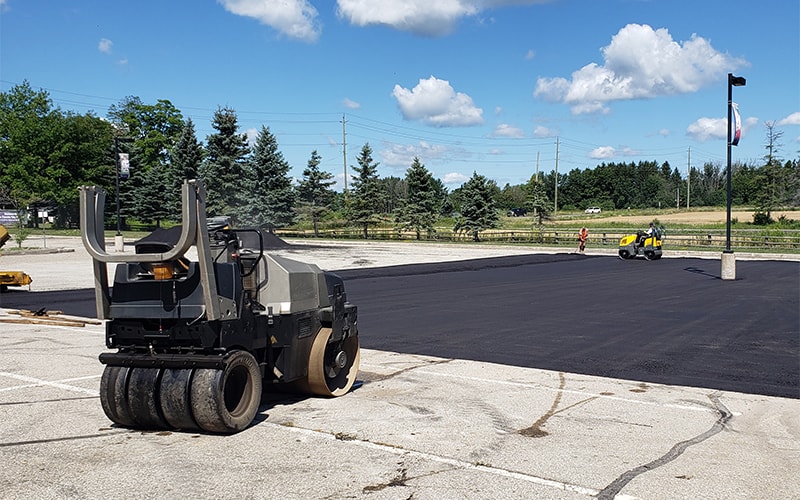
Our repair process uses saw-cut boundaries, hot-mix asphalt, calibrated compaction equipment, and proper tack coat application on every patch. For properties with recurring failures in the same locations, we assess the sub-base condition and recommend full-depth reclamation where the base cannot support a long-lasting surface repair.
We also work with property managers to build annual maintenance programs that prevent pothole formation rather than responding to it. A structured maintenance program that includes sealcoating, crack sealing, and drainage management consistently costs less over a 10-year horizon than reactive repair. Learn more about our full range of commercial services or reach out to schedule a site assessment that builds a pavement plan around your property.
Address Potholes at the Right Stage
The difference between a pothole that costs a few hundred dollars to fix and one that costs several thousand is almost always the time between when the problem started and when it was addressed. Surface cracks sealed early prevent water infiltration. Water infiltration caught before sub-base saturation prevents base failure. Base failure caught before the surface collapses prevents a pothole repair from becoming a full-depth reclamation project.
Commercial property managers who build proactive pavement inspection into their seasonal maintenance cycle consistently achieve longer pavement lifespans and lower total repair costs. If your lot has active potholes or developing distress that has not been assessed recently, contact Seal Canada to schedule a free site assessment.
Frequently Asked Questions
1. What causes potholes to keep forming in the same spot?
Recurring potholes in the same location almost always indicate a sub-base failure that surface patching alone has not resolved. Water is consistently reaching the base in that area through unaddressed drainage concentration, a nearby utility trench that has settled, or cracks that were not fully sealed. Each time the surface is patched without addressing the base condition, the repair lifespan shortens. Full-depth reclamation, which involves removing the surface and base material and rebuilding from the subgrade up, is the only repair approach that stops the cycle.
2. What is the difference between cold patch and hot-mix patching?
Cold patch is a pre-mixed asphalt material that can be applied without heat. It is a temporary measure for stabilizing a pothole when permanent repair cannot be scheduled immediately. It lacks the bond strength, structural integrity, and weather resistance of hot-mix asphalt. Hot-mix patching involves placing freshly mixed asphalt at the correct temperature, compacting it to the proper density, and bonding it to the existing pavement with tack coat. Hot-mix repairs last significantly longer and are the standard for permanent commercial pothole repair.
3. How quickly do potholes need to be repaired?
Any pothole in an active traffic zone should be barricaded immediately upon discovery and repaired as soon as materials and crew can be mobilized, typically within one to three business days for commercial properties. Under Ontario’s Occupiers Liability Act, a known hazard that is left unaddressed creates direct liability exposure for the property owner or manager. Prompt temporary mitigation followed by permanent repair is the correct response sequence.
4. Does sealcoating prevent potholes?
Sealcoating does not prevent potholes directly, but it addresses two of the three conditions that cause them. By replenishing oxidized binder oils, it keeps the asphalt surface flexible and crack-resistant. By sealing micro-pores, it reduces water infiltration that leads to sub-base saturation. A sealcoated surface is significantly more resistant to the freeze-thaw cracking that initiates pothole formation. Sealcoating on a regular two-to-three year cycle, combined with prompt crack sealing, substantially reduces pothole formation rates in commercial parking lots.
5. Is it worth repairing a parking lot with multiple potholes, or is resurfacing better?
When potholes are isolated to specific areas with intact pavement between them, targeted saw-cut patching is typically the better value. When potholes are widespread, the surface is extensively cracked, and the pavement is approaching the end of its service life, resurfacing becomes more cost-effective than patching each failure individually. Seal Canada’s site assessments include a condition rating that gives property managers a clear picture of which approach fits their lot’s actual state. More detail on the resurfacing decision is available on our asphalt resurfacing service page.
6. How much does commercial pothole repair cost in Ontario?
Cost depends on pothole size, depth, quantity, whether sub-base repair is required, and site accessibility. A standard saw-cut patch for an isolated surface pothole is considerably less expensive than a full-depth repair in a sub-base failure zone. Seal Canada provides written site assessments and itemized quotes for every commercial repair project so property managers can plan and budget before committing to any scope of work.
Request a Free Pothole Assessment
If your commercial parking lot has active potholes, recurring failures, or surface distress that has not been assessed recently, contact Seal Canada to schedule a free site assessment. Our team evaluates current pavement conditions, identifies the root cause of each failure, and provides a prioritized repair plan with written cost estimates.
Call us to get started.
Key Takeaways
- Potholes form through a predictable three-stage sequence: surface cracking, sub-base saturation, and surface collapse. Intervening at any stage prevents the next one.
- Surface-only potholes over an intact base are repaired with saw-cut hot-mix patching. Potholes over failed sub-base require full-depth reclamation to stop recurrence.
- Cold patch is a temporary hazard mitigation measure, not a permanent repair. It should always be followed by a proper hot-mix patch.
- Sealcoating, crack sealing, and drainage management are the three preventive actions that most directly reduce pothole formation rates in commercial parking lots.
- Ontario’s Occupiers Liability Act creates a duty of care for commercial property owners. A known and unaddressed pothole is direct liability exposure.
- Recurring potholes in the same location indicate sub-base failure. Surface patching alone will not resolve them permanently.