The weather effect on asphalt and concrete surfaces in Ontario operates through UV radiation, moisture infiltration, and freeze-thaw cycling, each degrading pavement through distinct but related mechanisms. Understanding how each weather factor works allows property managers to time protective treatments, drainage investments, and seasonal maintenance to address damage before it becomes structural.
Ontario’s Climate and Why It Is Particularly Hard on Pavement
Ontario’s climate creates one of the most demanding pavement service environments in North America. Commercial lots must withstand summer temperatures above 35 degrees Celsius, UV radiation levels that oxidize asphalt binders, freeze-thaw cycles that number 40 to 80 events per winter season depending on location, and exposure to de-icing chemicals across a six-month winter maintenance window. The Transportation Association of Canada documents Canadian climate-specific pavement performance data that underpins the maintenance standards Ontario commercial properties are designed to meet.
This combination of stresses attacks pavement through multiple simultaneous mechanisms. A lot that manages UV protection but neglects drainage will still fail prematurely. A lot that seals cracks but ignores sealcoating oxidizes at the surface and becomes vulnerable to infiltration within a few years. Effective pavement management addresses the full spectrum of weather effects, not individual stressors in isolation.
UV Radiation: The Slow Oxidizer
UV radiation from sunlight acts on asphalt through a process called photo-oxidation. The asphalt binder, the petroleum-based glue that holds aggregate particles together, absorbs UV energy and reacts with atmospheric oxygen. This chemical reaction progressively hardens and embrittles the binder, reducing the flexible behaviour that allows asphalt to accommodate thermal movement and load cycling without cracking.
Visible indicators of UV damage on asphalt include surface graying, a dry and dusty texture on the surface, and fine surface cracking that initially appears as a network of shallow lines. In advanced oxidation, these surface cracks develop into the interlocking pattern known as alligator cracking, which indicates that the binder has lost most of its cohesive capacity.
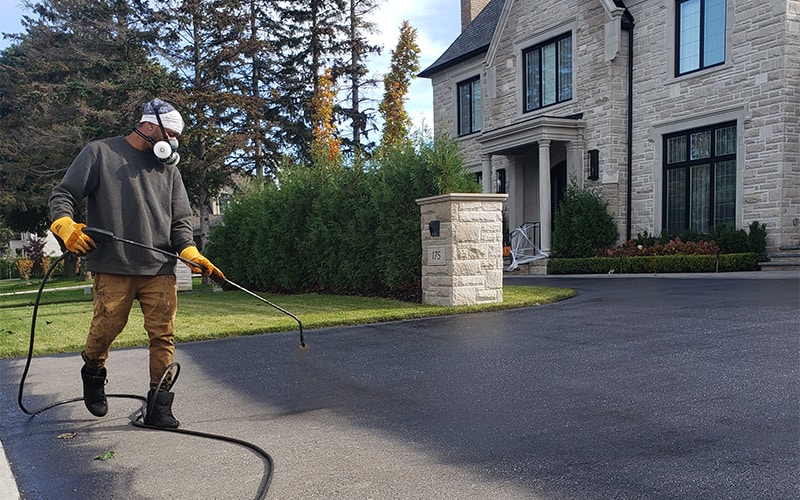
Sealcoating is the primary intervention against UV oxidation. A sealcoat applied before significant oxidation has occurred reflects UV radiation, dramatically slowing the photo-oxidation rate. Asphalt sealcoating on a three-to-five-year cycle is the most cost-effective response to the UV weather effect on asphalt surfaces. Natural Resources Canada publishes commercial surface protection and energy efficiency guidance that supports pavement protection planning for Ontario commercial properties.
Moisture and Precipitation: The Infiltrator
Rainfall and snowmelt infiltrate pavement surfaces through any available path: surface cracks, oxidation-damaged pore structure, failed joints, and inadequate drainage collection. Once inside the pavement structure, water attacks each layer differently.
In the asphalt surface course, water weakens the binder-aggregate bond, a process called stripping. Stripped areas lose aggregate particles from the surface, producing raveling that initially looks like surface roughening and progresses to loss of structural depth. In concrete, water infiltration promotes alkali-silica reaction in susceptible aggregate mixes and, critically, carries chloride ions from de-icing salt into the cover zone above steel reinforcement.
At the base and subbase layers, water washes fine particles out of the aggregate matrix through a process called pumping. Each wheel load above a water-saturated base forces fine material out through cracks, progressively creating voids below the pavement. Voids beneath the pavement produce the deflection under load that generates fatigue cracking and pothole formation. Crack sealing is the most direct intervention against moisture infiltration effects, preventing water from reaching the base and subbase layers where damage accumulates most rapidly.
Freeze-Thaw Cycling: The Mechanical Expander
The freeze-thaw weather effect on asphalt is the most mechanically damaging seasonal process in Ontario’s climate. Water infiltrates pavement through surface cracks during rain or snowmelt events. When temperatures drop below zero, that water expands by approximately nine percent as it freezes, applying pressure to surrounding pavement.
This expansion forces crack edges apart. As temperatures rise and the ice melts, the enlarged crack accepts more water during the next rain or melt event, and the following freeze cycle widens it further. Over a single winter, this process can transform a 3mm maintenance-level crack into a 25mm or wider structural crack.
Ontario commercial lots in exposed locations typically experience 40 to 80 complete freeze-thaw cycles per winter, meaning the expansion-contraction process repeats dozens of times each season on unprotected pavement. The cumulative effect is visible each spring as increased crack widths, new pothole development, and heaving sections where subgrade soils have also experienced frost penetration. Seal Canada’s commercial paving team can assess subbase conditions and recommend depth corrections as part of rehabilitation planning for properties experiencing significant frost heave.
Temperature Differential and Thermal Movement
Both asphalt and concrete expand when heated and contract when cooled. The magnitude of thermal movement depends on the temperature differential the material experiences, and Ontario’s climate produces significant differentials both seasonally and diurnally.
Asphalt’s flexible behaviour accommodates moderate thermal movement without cracking. However, oxidized asphalt with a hardened, embrittled binder loses this flexibility and cracks when thermal contraction stress exceeds the binder’s tensile strength. This is why UV oxidation and thermal cracking are related phenomena: the UV damage that hardens the binder creates the brittleness that thermal cycling then exploits.
Concrete manages thermal movement through expansion joints. These joints must remain functional, either filled with appropriate sealant or separated by a compressible material, to allow movement without stress concentration. Failed expansion joints in concrete surfaces allow thermal cracking to develop at predictable locations adjacent to the joint. Annual inspection and resealant application keep expansion joints functional through Ontario’s full temperature range.
Chemical Exposure from De-Icing Products
The de-icing chemicals applied to commercial lots each winter add a chemical weathering component to the physical effects of freeze-thaw cycling and UV exposure. Sodium chloride is the most commonly applied product but carries the highest pavement damage profile of standard de-icing options.
On asphalt, repeated salt application softens the binder by disrupting the chemical equilibrium of the asphalt cement at the surface boundary. This localized softening accelerates traveling and reduces the surface’s resistance to load deformation. On concrete, chloride ions from salt solution penetrate the surface layer and initiate steel reinforcement corrosion that causes concrete spalling as corroding steel expands. Environment and Climate Change Canada provides environmental assessment data for de-icing product alternatives that commercial property managers can use to evaluate options beyond standard rock salt. Calcium magnesium acetate and potassium acetate products cause significantly less pavement damage at equivalent de-icing performance.
Protective Strategies for the Weather Effect on Asphalt and Concrete
For UV Damage
Apply sealcoating on a three-to-five-year cycle based on surface condition at inspection. The timing, product selection, and post-application care that determine how effectively sealcoating combats UV oxidation are covered in Seal Canada’s guide to parking lot maintenance after sealcoating. For concrete, penetrating UV-resistant sealers provide surface protection without film-forming coatings that require removal before reapplication.
For Moisture and Freeze-Thaw Effects
Sealcoating, crack sealing, and drainage maintenance work together as the moisture protection system for the lot. No single treatment replaces the others. Regular crack sealing every one to two years between sealcoating cycles keeps moisture infiltration pathways closed through the service intervals when the sealcoat surface is being oxidized and worn by traffic. Seal Canada’s guide to parking lot winter preparation covers the fall treatment sequence that protects against Ontario’s most damaging freeze-thaw season.
For Thermal Movement
Preserving asphalt binder flexibility through timely sealcoating reduces the brittleness that thermal cycling exploits. For concrete, maintaining expansion joints in functional condition through annual inspection and resealant application prevents thermal stress from concentrating at joint locations and allows the pavement to move without cracking.
Managing Weather Effects Before They Become Repair Costs
The weather effect on asphalt and concrete surfaces in Ontario is constant and predictable. UV radiation, moisture infiltration, freeze-thaw cycling, and chemical exposure each follow a known seasonal pattern, allowing preventive maintenance to be scheduled before minor issues become major structural problems. Regular inspections, timely crack sealing, asphalt sealcoating, drainage improvements, and prompt repairs help reduce weather-related deterioration while extending pavement service life. By taking a proactive approach to pavement maintenance, commercial property owners can minimize unexpected repair costs, improve safety, and protect the long-term value of their investment.
Frequently Asked Questions
1. What is the most damaging weather effect on asphalt in Ontario?
Freeze-thaw cycling causes the most rapid structural damage to Ontario commercial asphalt, converting sealed hairline cracks into structural failures through repeated water expansion events over a single winter. UV oxidation is a slower process but creates the brittleness that makes freeze-thaw damage more severe by hardening the binder that needs to remain flexible to resist crack expansion.
2. How does UV radiation affect asphalt differently from concrete?
UV radiation oxidizes asphalt binder, hardening and embrittling it over time, which leads to surface cracking, raveling, and loss of structural flexibility. Concrete is less susceptible to direct UV damage but is affected by UV-accelerated carbonation and drying at the surface that can reduce cover zone durability over time.
3. How often should expansion joints in concrete be inspected and resealed?
Commercial concrete expansion joints should be inspected at least annually and resealed whenever the existing joint sealant shows cracking, debonding, or compression failure. A failed expansion joint allows concentrated thermal stress to crack the adjacent concrete panel and allows water infiltration at the most structurally vulnerable location.
4. What surface condition indicates that UV damage has become structural?
Alligator cracking, the interconnected pattern of cracks resembling reptile skin, indicates that UV oxidation has hardened the binder to the point where it can no longer accommodate load-induced deformation. At this stage, crack sealing and sealcoating are insufficient. The affected area requires removal and replacement or a structural overlay.
5. How does de-icing salt damage concrete differently from asphalt?
On concrete, chloride ions from salt solution penetrate the surface and migrate to the steel reinforcement depth, initiating corrosion. Expanding corrosion products create internal pressure that causes the concrete cover to spall and delaminate. This damage is progressive and, once initiated, cannot be reversed without removing the affected concrete and replacing the cover zone.
6. Can weather damage be reversed once it becomes visible on the surface?
Surface-level UV oxidation can be significantly slowed and surface function restored through sealcoating, but oxidation of the binder below the surface cannot be reversed. Freeze-thaw crack damage can be sealed to prevent further progression. Subbase erosion from moisture infiltration requires corrective repair once it has produced visible surface distress. The most effective response is always prevention before visible damage appears.
Protect Your Commercial Pavement with Preventive Maintenance
Seal Canada provides the complete range of protective treatments for commercial asphalt and concrete surfaces across Ontario: condition assessments, asphalt sealcoating, crack sealing, drainage inspection, and pavement repair. Browse our completed projects to see the commercial work we deliver across Ontario, or contact our team to discuss a maintenance program matched to your property’s pavement condition and climate exposure.
Key Takeaways
- UV radiation hardens asphalt binder through photo-oxidation, creating the brittleness that freeze-thaw cycling then exploits. Sealcoating is the primary UV protection measure.
- Moisture infiltration through surface cracks damages all pavement layers: binder-aggregate bonding in asphalt, reinforcement protection in concrete, and bearing capacity in the granular base.
- Ontario commercial lots experience 40 to 80 freeze-thaw cycles per winter. Crack sealing before freeze events is the most cost-effective response to this primary damage mechanism.
- De-icing salt initiates reinforcement corrosion in concrete and softens asphalt binder at the surface boundary. Lower-damage alternatives including calcium magnesium acetate reduce cumulative chemical weathering.
- No single treatment addresses all weather effects on asphalt. Sealcoating, crack sealing, drainage maintenance, and seasonal inspection work together as the complete protection system.