A safe parking lot protects customers, reduces liability, and reflects directly on your business. This guide covers the most effective strategies for parking lot safety, from surface maintenance and lighting to traffic design and accessibility compliance, with practical steps property managers can implement today.
Why Parking Lot Safety Is a Business Priority
Your parking lot is the first and last point of contact customers have with your property. A poorly maintained or poorly designed lot creates real hazards: cracked surfaces trip pedestrians, faded markings confuse drivers, and dim lighting invites both accidents and criminal activity. Every incident on your lot carries potential liability, and a history of safety complaints damages your reputation in ways that are difficult to reverse.
Property managers who invest in parking lot safety consistently see lower insurance claims, higher tenant satisfaction scores, and fewer emergency repair calls. The cost of proactive maintenance is a fraction of the cost of a single liability settlement.
Surface Maintenance Is the Foundation of Parking Lot Safety
No amount of signage or lighting compensates for a deteriorated surface. Cracks, potholes, and uneven pavement are the most common causes of vehicle damage and pedestrian injuries in commercial parking lots. Surface maintenance starts with identifying problems early, before they become structural failures.
Conduct visual inspections of the full lot at least monthly and after every significant weather event. Document what you find and prioritize repairs by severity. Cracks wider than 6mm or any pothole that creates a tripping hazard require immediate attention.
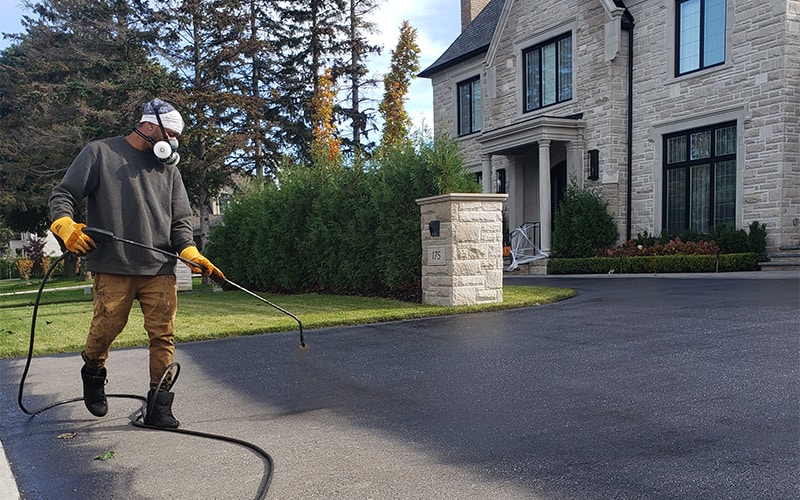
For surface cracks, crack sealing applied early is the most cost-effective intervention available. It stops water infiltration that would otherwise undermine the subbase and create the potholes you are trying to prevent. For lots showing significant surface wear or oxidation, asphalt sealcoating restores a uniform, grippy surface that reduces slip risk in wet conditions.
Lighting That Actually Covers the Lot
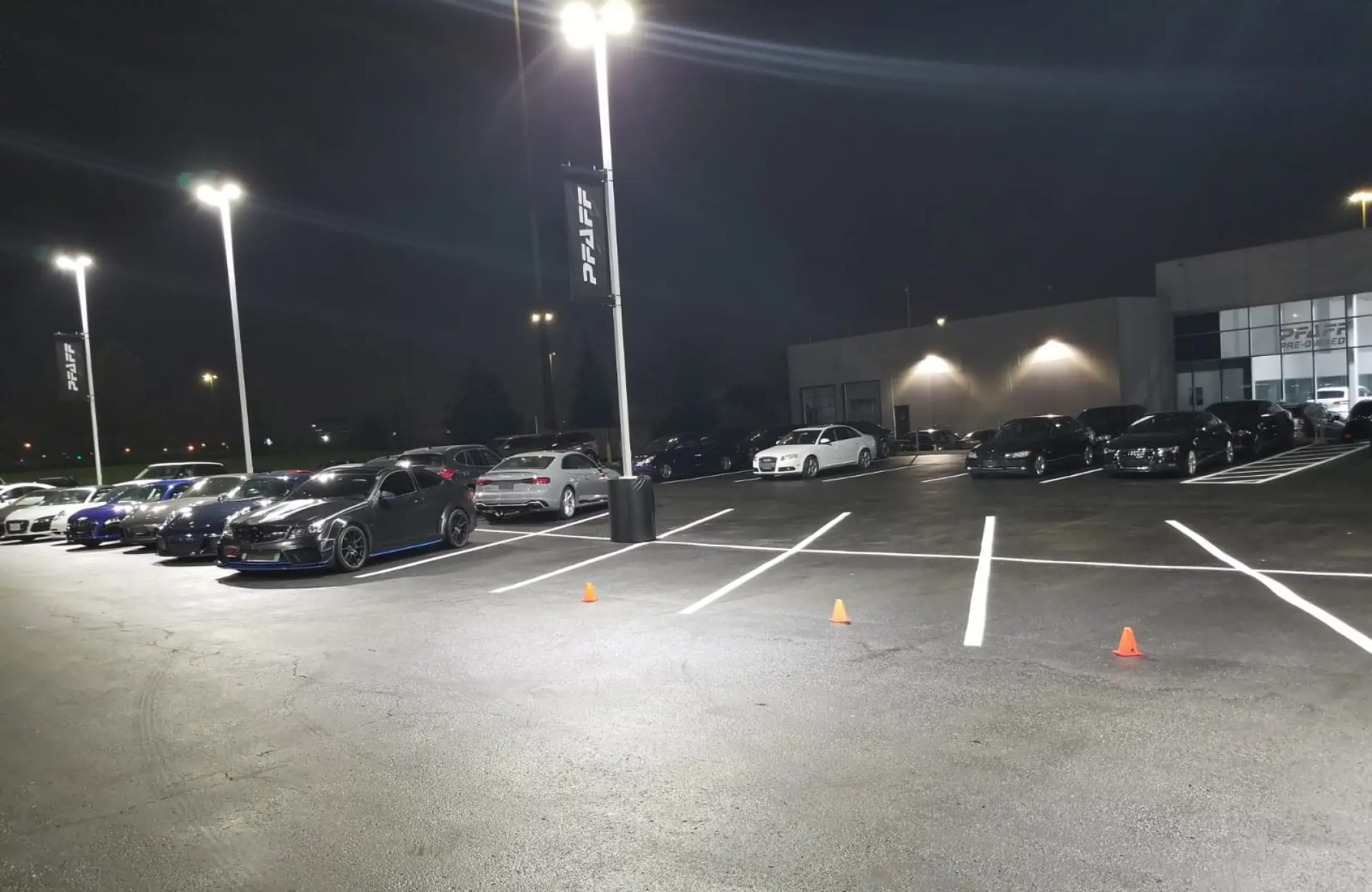
Inadequate lighting is one of the most commonly cited factors in parking lot security incidents and after-dark accidents. Lighting must cover the entire lot uniformly, not just the perimeter or main entrance. Dark pockets between rows, near stairwells, and along pedestrian pathways to building entrances are where incidents cluster.
LED fixtures provide better lumen output per watt than older HID alternatives, last significantly longer, and maintain consistent colour rendering that improves visibility for both cameras and human eyes. Motion-activated lighting in lower-traffic zones reduces energy cost without sacrificing coverage when someone is present.
Natural Resources Canada publishes energy efficiency guidelines that apply directly to commercial parking lot lighting selection and help property managers identify eligible incentive programs for LED retrofits.
Signage and Pavement Markings That Guide, Not Confuse
Clear signage and well-maintained pavement markings are the traffic management system of your parking lot. Faded line markings create ambiguity about lane direction, space boundaries, and pedestrian crossing locations. Ambiguity leads directly to conflicts between vehicles and between vehicles and pedestrians.
Directional arrows, space boundary lines, accessible space markings, pedestrian crosswalk lines, and speed advisory signs all need to be legible from the driver’s approach distance. After any sealcoating application, line painting must be redone with high-visibility paint to restore marking clarity.
The Transportation Association of Canada publishes pavement marking standards that apply to private commercial lots as well as public roads. Adhering to these standards keeps your markings consistent with the visibility and layout requirements recognized nationally.
Traffic Design That Reduces Conflict Points
Most parking lot accidents happen at predictable locations: unsignalized intersections within the lot, areas where pedestrian routes cross drive lanes, and tight corners where sight lines are poor. The goal of traffic design is to reduce the number of these conflict points and manage the ones that cannot be eliminated.
One-way drive lanes reduce the frequency of head-on conflicts. Designated pedestrian routes with clearly marked crossings separate foot traffic from moving vehicles. Speed humps positioned before pedestrian crossings slow vehicles before the crossing, not after.
For lots that need a full redesign or significant layout changes, Seal Canada’s commercial paving team can assess current conditions and recommend layout modifications as part of a surface rehabilitation project.
Security Measures That Deter and Document
Physical security infrastructure reduces criminal activity and provides documentation when incidents do occur. Visible surveillance cameras at lot entrances, exits, pedestrian access points, and blind corners deter theft and vandalism. Camera placement should be documented and reviewed by your insurer, as coverage quality directly affects claim outcomes.
Emergency call stations at strategic locations give customers a direct line to security or emergency services. They also signal that the property takes safety seriously, which affects customer perception. For a broader overview of technology-driven approaches, Seal Canada’s guide on parking lot security covers surveillance, access control, and surface integration in detail.
The Insurance Bureau of Canada provides commercial property safety resources that include parking lot security standards relevant to Ontario property managers.
Accessibility and Regulatory Compliance
Ontario’s Accessibility for Ontarians with Disabilities Act (AODA) sets requirements for accessible parking space dimensions, placement relative to building entrances, and pathway continuity from the lot to the door. Non-compliance is not only a legal risk but creates real barriers for customers with mobility needs.
Accessible spaces must be located on the shortest accessible route to the primary building entrance, with adequate transfer zones and compliant signage. Pedestrian pathways from accessible spaces to entrances must be smooth, obstacle-free, and clearly differentiated from vehicle lanes.
Regular accessibility audits catch compliance gaps before they become complaints or legal issues. AccessNow provides accessibility compliance resources relevant to commercial properties across Ontario. Seal Canada’s commercial pavement services include accessible space markings and pathway surface work as standard elements of commercial lot projects.
Seasonal Maintenance That Addresses Ontario’s Climate
Ontario’s freeze-thaw cycle is one of the harshest pavement conditions in North America. Water infiltrating through unsealed cracks freezes in winter, expands, and forces cracks wider. Spring melt reveals the accumulated damage from the full winter season. Without a proactive fall maintenance program, each spring brings a longer repair list.
Fall crack sealing before the first freeze is the highest-value seasonal maintenance activity for parking lot safety. It prevents the freeze-thaw expansion cycle from turning hairline cracks into potholes over the winter. Surface repairs completed in late summer or early fall give the pavement time to cure and set before cold weather arrives.
For lots that have reached the end of their service life, asphalt resurfacing is a comprehensive solution that restores the full surface, eliminates accumulated distress, and resets the maintenance clock. Understanding how sealcoating extends asphalt life helps property managers plan the right intervention at the right time.
Building a Parking Lot Safety Program That Lasts
A one-time repair addresses today’s problems. A safety program addresses them systematically, year after year. The most effective programs combine a documented inspection schedule, a prioritized repair list updated after each inspection, a defined maintenance cycle for crack sealing and sealcoating, and a clear responsibility assignment for each maintenance task.
Seal Canada works with commercial property managers across Ontario to build and execute multi-year maintenance programs that keep parking lot safety standards consistent without budget surprises. Review our completed projects to see the scope of work we handle for commercial clients, or reach our team to discuss a maintenance program for your property.
Frequently Asked Questions
1. How often should a commercial parking lot be inspected for safety hazards?
A minimum monthly inspection is recommended for commercial lots under active use, with additional inspections after significant weather events. High-traffic lots benefit from bi-monthly walkthroughs. Document findings at each inspection to build a maintenance record that supports liability defence if an incident occurs.
2. What pavement surface conditions create the highest safety risk?
Potholes and raised pavement edges create the highest immediate risk for vehicle damage and pedestrian trips. Active surface cracking wider than 6mm and areas with significant heaving from frost damage are the next priority. Faded line markings and missing accessible space signage create legal compliance risk alongside physical hazard.
3. What lighting standard should a commercial parking lot meet?
The Illuminating Engineering Society (IES) recommends a minimum average of 1 to 2 foot-candles for commercial parking lots with higher levels at entry and exit points, pedestrian crossings, and areas near building entrances. LED fixtures with a Colour Rendering Index above 70 improve visibility for both cameras and people.
4. What are the Ontario AODA requirements for parking lot accessibility?
Ontario AODA requires accessible parking spaces to meet specific dimension standards, be located on the shortest accessible route to the building entrance, include compliant signage, and connect to an accessible pedestrian pathway. The number of required accessible spaces is determined by total lot size under provincial standard.
5. How does regular crack sealing improve parking lot safety?
Crack sealing prevents water infiltration that undermines the subbase and creates potholes. It also eliminates the surface trip hazard that open cracks present to pedestrians. Proactive crack sealing significantly reduces the frequency of surface failures that require emergency repair.
6. Does parking lot condition affect commercial property insurance?
Yes. Many commercial property insurers assess parking lot condition as part of underwriting. Properties with documented maintenance programs, current inspections, and well-maintained surfaces typically receive more favourable terms. A history of parking lot incidents can increase premiums or restrict coverage.
Planning Ahead: How Seal Canada Supports Your Parking Lot Safety Program
The most common time property managers address parking lot safety is after an incident. The most effective time is before one. Seal Canada provides free site assessments for commercial properties across Ontario, identifying surface hazards, lighting gaps, marking deficiencies, and accessibility issues before they become claims or complaints.
Our commercial paving services cover the full scope of parking lot safety maintenance: asphalt repairs, crack sealing, sealcoating, accessible space markings, and line painting. Properties we have completed across the GTA are documented in our project portfolio. Contact our team to schedule your site assessment.
Key Takeaways
- Monthly visual inspections with documented findings are the foundation of a proactive parking lot safety program.
- Fall crack sealing before the first freeze prevents pothole formation through winter and is the highest-value seasonal maintenance investment for Ontario lots.
- Adequate LED lighting across the full lot, not just perimeter fixtures, reduces both accident risk and criminal activity.
- Line markings, accessible space compliance, and directional signage must be legible and current. Faded markings are a liability, not just an aesthetic issue.
- A multi-year maintenance program delivered by a single commercial paving partner keeps standards consistent and costs predictable across the full maintenance cycle.