Choosing the right paving contractor in Canada comes down to documented commercial experience, clear written proposals, proper insurance, and materials specified to match the job. This guide walks through each criterion so you can evaluate contractors with confidence before any work begins.
Why the Selection Decision Has Long-Term Consequences
The wrong paving contractor delivers short-term savings and long-term problems. Under-specified asphalt, inadequate compaction, and poor subbase preparation produce pavement that fails within two to three years instead of ten to fifteen. Every dollar saved on a low-bid contractor typically returns as three to five dollars in premature repair costs.
For commercial property owners and managers across Ontario, the pavement decision is also a liability decision. Poorly maintained or poorly constructed surfaces create exposure for slip-and-fall incidents, vehicle damage claims, and accessibility complaints. Choosing a contractor with genuine commercial experience and proper credentials protects both the asset and the people who use it.
Verify Commercial Experience Specifically
Residential and commercial paving are not the same discipline. Commercial lots carry heavier axle loads, require deeper asphalt sections, involve more complex drainage engineering, and demand project management capability to minimize disruption to tenant operations. Ask contractors specifically about commercial projects of comparable scale and request references from property management companies you can contact directly.
A contractor who lists primarily residential driveways on their portfolio is not automatically qualified to execute a 50,000 square foot commercial lot to proper specification. The commercial paving scope of work requires a different level of planning, equipment, and crew coordination than residential work.
Confirm Licensing, Insurance, and WSIB Compliance
Ontario paving contractors working on commercial sites must carry general liability insurance and maintain current WSIB (Workplace Safety and Insurance Board) clearance for all workers. Request current certificates before signing any agreement. A legitimate contractor provides these without hesitation.
Licensing requirements vary by municipality. Verify that the contractor holds permits required to operate paving equipment on your site or adjacent roadways, particularly for projects near public roads or within active commercial developments.
The CSA Group and National Research Council both publish standards relevant to commercial construction contractor competency in Canada. Contractors working to these standards should be able to reference them directly when discussing project specification.
Require a Full Written Proposal
Vague proposals are how cost overruns and disputes originate. A trustworthy paving contractor provides a written proposal that specifies:
- Asphalt mix type and layer thicknesses by course (e.g., HL3 surface, HL8 base).
- Subbase preparation method and compaction standard.
- Crack and patch repair scope included before paving.
- Project start date, completion date, and phasing plan if applicable.
- Warranty duration, coverage scope, and exclusions.
Any contractor who resists providing specification detail in writing is a material risk. If the proposal only lists a total price, ask for a line-item breakdown before proceeding. This also makes it easier to compare bids fairly across three contractors quoting the same scope.
Evaluate Material Quality and Equipment
The quality of asphalt mix directly affects how long the pavement performs. Ask which plant supplies the contractor’s asphalt and whether they can provide plant certification. Hot mix asphalt begins cooling as soon as it leaves the plant, and contractors working with inefficient logistics or inadequate haul equipment deliver degraded material that compacts poorly and fails earlier.
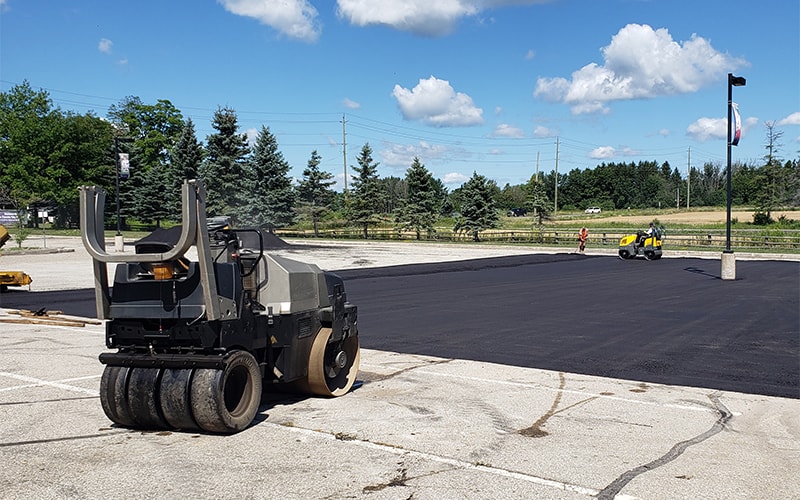
Compaction equipment matters equally. Under-compacted asphalt loses structural integrity and deteriorates through rutting and fatigue cracking significantly ahead of properly compacted pavement. Ask to see the compaction rollers the contractor will deploy and verify they are appropriately sized for the project scale.
For properties that need surface restoration before new paving, understanding asphalt resurfacing helps clarify what proper rehabilitation involves and what specification to expect from a competent contractor.
Understand Warranty Terms Before You Sign
Industry standard for commercial asphalt paving is a one to five year workmanship warranty depending on project scope and material specification. Warranty terms must be written and specific. Verbal assurances are not enforceable.
Review warranty terms for: what failures trigger coverage, what the remediation process is, how long the contractor has to respond to warranty claims, and what conditions void coverage. A contractor who deflects warranty questions or provides vague verbal commitments is not a contractor to trust with a major commercial asset.
The strongest contractors also offer planned maintenance services after project completion. A paving partner invested in your pavement’s long-term performance is more valuable than a contractor who finishes and moves on. Ask whether sealcoating and crack sealing services are available through the same contractor, as continuity reduces handoff risk in pavement management.
Ask the Right Questions Before Committing
Use these questions during contractor evaluation to surface capability gaps before they become project problems:
- What asphalt mix specification will you use, and which plant will supply it?
- What subbase preparation is included in your scope and to what compaction standard?
- Can you provide current certificates of insurance and WSIB clearance today?
- Who is the site supervisor and what commercial projects have they managed?
- What is your process if issues arise during or after the project?
Contractors who answer these questions confidently and in writing are the ones worth proceeding with. Those who deflect, give vague answers, or ask you to trust them on the details are not.
Watch for These Warning Signs
Several patterns appear consistently in contractor selections that go wrong:
- Request for full payment upfront before work begins.
- No written proposal, or a proposal that lists only a total price with no specification.
- Unable or unwilling to provide insurance certificates or WSIB clearance.
- References only from residential clients, no commercial property management contacts.
- Price dramatically lower than competing quotes with no explanation of scope differences.
A price significantly below other quotes almost always reflects a scope difference. Ask the low bidder to explain specifically what is different. If they cannot, the gap is in material quality or labour depth, not efficiency.
For guidance on parking lot line striping standards and what to expect post-paving, that reference provides a useful baseline for evaluating contractor completeness. The Transportation Association of Canada also publishes best practice frameworks for commercial pavement that experienced contractors should be familiar with.
Why Seal Canada Is the Right Partner for Your Commercial Property
Seal Canada brings documented commercial paving experience to projects across Ontario, from large industrial lots to multi-tenant retail centers. Every project includes a full written proposal with material specification, a defined warranty, and post-project maintenance services including crack sealing and sealcoating.
Our team works with property managers, developers, and facility directors to deliver pavement that performs as specified and is backed by a service relationship, not a one-time transaction. Contact our team to request a site assessment and written proposal for your commercial property.
Frequently Asked Questions
1. What should a commercial paving proposal always include?
A complete commercial paving proposal must specify asphalt mix type and layer thicknesses by course, subbase preparation scope and compaction standard, crack and patch repair included in scope, project timeline with start and completion dates, and warranty terms with duration and coverage definition.
2. How do I verify a paving contractor’s credentials in Ontario?
Request current general liability insurance certificates and WSIB clearance certificates before any work begins. Ask for proof of municipal permits where required. A legitimate contractor provides all of these without hesitation.
3. How many quotes should I get for a commercial paving project?
Three quotes from qualified commercial contractors provide meaningful comparison. Evaluate each proposal on specification completeness, not price alone. A proposal that omits specification detail should not be accepted even if it carries the lowest number.
4. What warranty is standard for commercial asphalt paving?
Industry standard ranges from one to five years depending on project scope and material specification. Warranties must be written and specific, covering material and workmanship failures with a defined remediation timeline.
5. Can a residential paving contractor handle commercial parking lot work?
Not reliably. Commercial lots require deeper asphalt sections, heavier compaction equipment, more complex drainage engineering, and project management capability that residential-only contractors typically lack. Verify specifically that the contractor has completed commercial projects of comparable scale.
6. What does WSIB clearance mean for a paving contractor?
WSIB (Workplace Safety and Insurance Board) clearance confirms that the contractor has registered workers and is currently on premiums. Without it, property owners can be held liable for workplace injuries that occur on their site during the project.
7. How does material quality affect pavement performance?
Asphalt mix specification, plant proximity, and compaction quality all directly affect how long the pavement performs. Under-specified mixes, poorly compacted lifts, and degraded material from long hauls produce pavement that fails in two to three years instead of ten to fifteen.
Make the Right Decision Before Work Begins
Selecting a qualified paving contractor in Canada protects your property, your budget, and the people who use the pavement every day. The criteria in this guide give you a structured basis for evaluation that goes beyond price comparison.
Seal Canada has built its reputation on delivering commercial paving work that meets specification, is backed by written warranties, and is supported by long-term maintenance services. Reach out to our team to schedule a site visit and receive a detailed written proposal for your project.
Key Takeaways
- Commercial paving and residential paving are different disciplines. Verify commercial project references specifically before engaging any contractor.
- Always require a written proposal with full material specification, layer thicknesses by course, and warranty terms before signing any agreement.
- Request current insurance certificates and WSIB clearance before work begins. These protect you from liability on your own property.
- Three competitive quotes evaluated on specification completeness, not price alone, give you the comparison data needed to make a sound decision.
- The lowest bid almost always reflects a scope difference. Ask the low bidder to explain specifically what is different before accepting.
- Warranty terms must be written, specific, and enforceable. Verbal commitments from any contractor are not adequate protection.
- A contractor who also offers post-project sealcoating, crack sealing, and line marking services is a more valuable long-term partner than one who moves on after paving is complete.