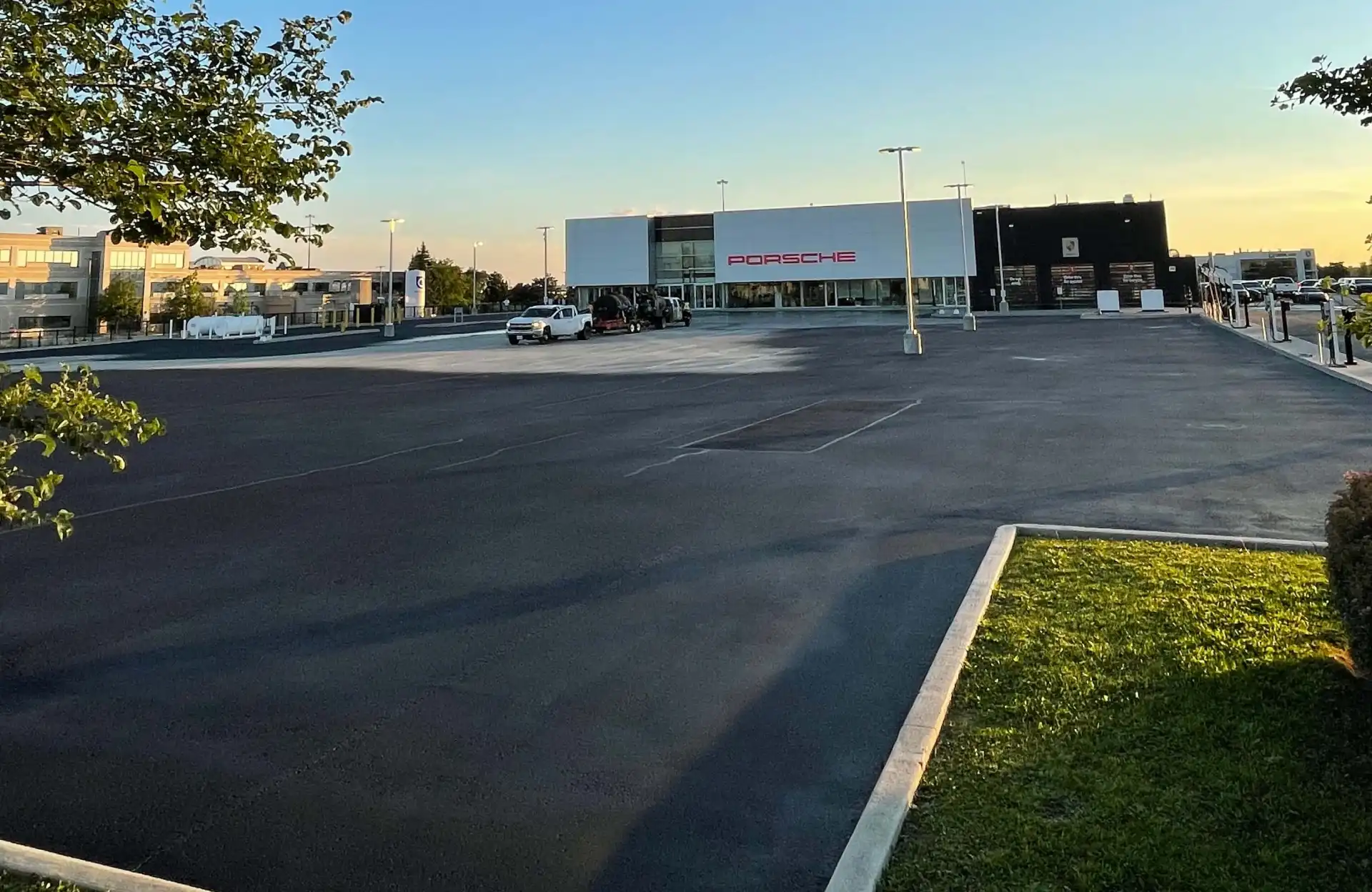
Commercial parking lots can significantly reduce their environmental footprint through permeable paving, recycled materials, energy-efficient lighting, and green infrastructure without compromising functionality. This guide covers the most impactful strategies Ontario property owners and managers can act on today.
Why an Eco-Friendly Parking Lot Matters for Your Property
Parking lots are among the most environmentally costly surfaces in the built environment. Conventional impermeable asphalt generates substantial stormwater runoff, absorbs heat that raises local temperatures, and requires repeated raw material use through its lifecycle. For commercial property owners, this creates both environmental liability and rising infrastructure costs. Building an eco-friendly parking lot addresses these issues directly and reduces stormwater management costs, lowers energy operating expenses, supports municipal sustainability compliance, and positions a property favourably in a market where tenants and investors increasingly evaluate environmental performance.
Start with Permeable Paving Where Possible
Conventional asphalt generates 100 percent surface runoff during rainfall events, sending water loaded with tire particles, oil residue, and suspended solids directly into storm drains. Permeable pavement is one of the most impactful upgrades available for an eco-friendly parking lot, allowing water to infiltrate through the surface and into a gravel base layer where it is filtered before reaching groundwater.
Two main options suit Ontario commercial applications:
- Porous asphalt: an open-graded asphalt mix with a void structure that allows water infiltration. It installs and performs like standard asphalt for vehicle loads and can be maintained with standard equipment.
- Pervious concrete: a coarse aggregate concrete mix with controlled void content. It provides the structural performance of concrete with significant permeability.
Both options reduce stormwater management infrastructure requirements, which can meaningfully reduce site development costs. The U.S. Environmental Protection Agency documents permeable pavement performance data including pollutant reduction rates relevant to Canadian municipal stormwater requirements.
Use Recycled Materials to Reduce Resource Demand
The raw material demand of conventional asphalt construction is substantial. Two recycled material options reduce that demand significantly without compromising structural performance:
- Reclaimed asphalt pavement (RAP): milled material from old roads and lots reprocessed into new asphalt mix. RAP reduces raw bitumen and aggregate demand, lowers material cost, and diverts construction waste from landfill.
- Recycled concrete aggregate (RCA): crushed concrete from demolished structures used as granular subbase. RCA reduces the volume of quarried virgin aggregate required and productively reuses demolition material.
Seal Canada’s commercial paving projects incorporate recycled material options where site and mix design conditions support it, and can advise on the proportion of recycled content appropriate for each application.
Incorporate Green Infrastructure Into the Layout
Green infrastructure integrates natural water management elements directly into the parking lot design rather than relying entirely on engineered drainage systems. The two most effective applications for commercial lots are:
- Rain gardens: shallow planted depressions positioned at the edges of parking lots or within landscape islands that capture and filter stormwater runoff before it enters storm drains. They reduce runoff volume, improve water quality, and create biodiversity habitat within an otherwise hardscaped site.
- Bioswales: vegetated channels that direct stormwater flow while filtering out suspended solids and nutrients. They perform the same function as concrete channel drains with a substantially lower environmental footprint.
Native plantings in parking lot landscape islands and perimeter areas reduce irrigation demand, eliminate fertilizer and pesticide inputs, and support local insect and bird populations. The Transportation Association of Canada includes green infrastructure guidance in its sustainable pavement frameworks applicable to Canadian commercial developments.
Upgrade to Energy-Efficient Lighting
Parking lot lighting is one of the largest operating energy expenses for commercial properties. Conventional HID (high-intensity discharge) fixtures are energy-intensive, require frequent lamp replacement, and provide inconsistent colour rendering. LED replacements use 40 to 60 percent less energy, last three to five times longer, and provide better visibility for both occupants and surveillance cameras.
Solar-powered LED fixtures eliminate the electrical infrastructure cost of new light standard runs in lots that are expanding or undergoing layout changes. Motion-activated controls in lower-use areas of the lot further reduce energy consumption without sacrificing coverage when occupancy triggers activation. Natural Resources Canada publishes commercial lighting efficiency programs that include rebate eligibility for LED retrofit projects, providing a direct financial return on the sustainability investment for Ontario commercial properties.
Install EV Charging Infrastructure
Electric vehicle adoption in Ontario is accelerating, driven by federal and provincial incentive programs and expanding model availability. Commercial properties that lack EV charging infrastructure are already at a disadvantage for attracting tenants and customers who drive EVs, and the gap will widen as EV ownership grows.
EV charging stations require dedicated paved surfaces with load-rated specifications and clearly marked parking spaces. Planning EV infrastructure at the same time as a paving project reduces disruption and allows conduit runs to be incorporated during construction rather than retrofitted with costly saw-cutting later. Government of Canada incentive programs for commercial EV charging infrastructure can offset a significant portion of installation cost. A qualified electrical contractor can identify applicable programs at the time of installation planning.
Choose Sustainable Maintenance Products
The sealcoating and maintenance products applied to a parking lot contribute to its overall environmental profile. Coal tar-based sealcoating products contain polycyclic aromatic hydrocarbons (PAHs) that are regulated in a growing number of Ontario municipalities. Asphalt emulsion sealcoating is the compliant alternative and performs well across Ontario’s climate range, extending pavement life and reducing the frequency of full replacement.
Water conservation in maintenance operations, including using collected rainwater for pressure washing and minimising runoff from cleaning activities, reduces the environmental footprint of ongoing lot management. Proper collection and disposal of wash water containing oil and chemical residues prevents contaminant discharge into stormwater systems. After any maintenance work, line painting with low-VOC paint completes the environmental profile of the maintenance cycle. Browse our completed projects to see how Seal Canada applies these practices across commercial properties in Ontario.
Reduce Urban Heat Island Effect Through Surface Selection
Dark asphalt surfaces absorb solar energy and re-radiate it as heat, raising ambient temperatures in and around commercial lots by several degrees compared to vegetated surfaces. This urban heat island effect increases cooling energy demands for adjacent buildings and contributes to elevated local temperatures on hot days. Choosing the right surface materials is one of the most overlooked steps in designing an eco-friendly parking lot.
Strategies to reduce heat island contribution include using lighter-coloured surface aggregate in asphalt mixes, applying reflective sealcoating products where appropriate, increasing tree canopy over parking areas, and incorporating green infrastructure that provides evaporative cooling. Any increase in permeable or vegetated surface area within the lot directly reduces heat island contribution.
Sustainable Paving Choices That Work for Your Property and the Environment
Municipal stormwater compliance requirements, rising energy costs, and tenant sustainability expectations have made eco-friendly parking lot design a standard consideration for commercial property owners across Ontario. Permeable paving, recycled materials, native plantings, LED lighting, EV infrastructure, and sustainable maintenance products each reduce the environmental footprint of the lot independently and reinforce each other as a system.
Frequently Asked Questions
1. What is an eco-friendly parking lot?
An eco-friendly parking lot uses permeable pavement, recycled materials, green infrastructure, energy-efficient lighting, and sustainable maintenance products to reduce stormwater runoff, lower energy consumption, minimise raw material demand, and decrease heat island effect, all while maintaining full vehicle and pedestrian functionality.
2. Does permeable pavement perform adequately under commercial vehicle loads in Ontario?
Yes. Porous asphalt and previous concrete can be specified to commercial load-bearing standards appropriate for standard vehicle traffic including light delivery trucks. Mix design and base specification must account for the intended traffic. Permeable pavements are not typically appropriate for heavy truck terminal applications without engineering review.
3. What government incentives are available for eco-friendly parking lot features in Ontario?
Federal and provincial programs offer incentives for EV charging infrastructure installation, LED lighting upgrades, and certain green infrastructure projects. Eligibility and program availability change regularly. Consult Natural Resources Canada, the Canada Infrastructure Bank, and your local municipality for current programs at the time of your project.
4. How do recycled asphalt materials compare to virgin asphalt in performance?
Properly processed reclaimed asphalt pavement (RAP) meets standard commercial pavement performance specifications. When incorporated at appropriate proportions in mix design, RAP delivers equivalent durability to virgin asphalt mixes while reducing raw material demand and project cost.
5. Can green infrastructure be added to an existing parking lot?
Yes. Rain gardens, bioswales, and native plantings can be incorporated at lot perimeter, within landscape islands, and in underutilised corner areas without requiring a full reconstruction. These retrofits are often feasible as part of a rehabilitation or sealcoating project.
6. How does sealcoating fit into an eco-friendly maintenance program?
Asphalt emulsion sealcoating is the environmentally compliant choice for Ontario commercial lots. It extends pavement life, which reduces the frequency of replacement and the raw material demand that comes with it. Choosing a low-PAH or PAH-free sealcoating product directly reduces chemical discharge risk from lot runoff.
Discuss Eco-Friendly Paving Solutions for Your Property
Seal Canada helps commercial property owners and managers incorporate sustainable paving practices into new construction and rehabilitation projects across Ontario. Contact our team to discuss which eco-friendly paving options are appropriate for your property and how they can be implemented within your capital program.
Key Takeaways
- Permeable paving reduces stormwater runoff at the source, decreasing both environmental impact and stormwater management infrastructure costs.
- Recycled asphalt pavement and recycled concrete aggregate reduce raw material demand without compromising commercial load performance.
- LED parking lot lighting uses 40 to 60 percent less energy than conventional HID fixtures and lasts three to five times longer.
- Green infrastructure, including rain gardens and bioswales, manages stormwater naturally while adding ecological value to otherwise hardscaped sites.
- An eco-friendly parking lot combines multiple complementary strategies, each of which adds value independently while reinforcing the others as a system.